Beth reveals her approaching death
Little WomenBeth reveals her approaching death in a quiet seaside conversation with Jo, turning a suspicion that has been privately gathering into shared knowledge. The disclosure is decisive because it changes illness from a condition the family hopes to defeat into a reality Beth and Jo must learn to face together; it also becomes the moment when Beth prepares Jo to assume new responsibilities and discovers that love, rather than future ambition, will outlast physical life.
The Change Jo Sees
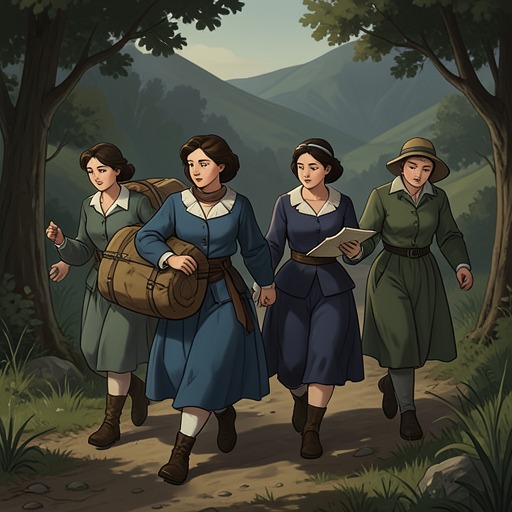
When Jo returns in spring, absence has sharpened her perception of Beth. The change is gradual enough to escape the notice of those who see Beth every day, but to Jo the girl appears thinner and almost transparent, as though the mortal body were slowly being refined away. Beth seems happy and no one openly doubts that she is improving, yet Jo cannot dismiss the impression that her sister is fading. Her anxiety returns after Laurie leaves, and she takes Beth to the seashore, where Beth can remain near home while breathing the open air and receiving the sea breezes.
At the shore, the sisters become almost entirely absorbed in one another. Beth is too shy for society, and Jo is too devoted to Beth to seek it; their closeness therefore carries both comfort and foreboding. The people around them watch the strong sister and the feeble one moving together as if they sense that another separation is approaching. Jo feels a veil between them, but hesitates to lift it, treating the silence as something sacred and waiting for Beth to speak first.
The Confession
One day, while Beth lies still and Jo studies her face for signs of recovery, Jo understands more bitterly than before that Beth is drifting away. Beth then looks at her with tenderness and acknowledges that she is glad Jo knows. She explains that she has tried to tell her but could not. The revelation does not arrive as a dramatic announcement; it emerges from an intimate act of recognition, when Jo's observation finally meets the truth Beth has been carrying alone.
Beth confirms that the autumn's unhappiness came from this knowledge. She had already given up hope but resisted admitting it, trying to treat the conviction as a sick fancy so that it would not burden anyone. Watching the others remain strong and make happy plans made her feel that she could never share their future, and the resulting loneliness made her miserable. Jo is distressed not only by the prospect of losing Beth but by the fact that Beth endured the fear without allowing her sister to comfort or help her.
Beth describes her decline through the image of a turning tide: each day she loses a little and becomes more certain that what has gone cannot be recovered. Jo rejects this acceptance. She insists that nineteen is too young, promises to work, pray, and fight against the illness, and refuses to believe that Beth must leave her. The exchange creates the central value shift of the scene: Jo moves from the hope of cure and resistance to the painful knowledge that love cannot preserve Beth's body, while Beth moves from concealed suffering to the relief of being understood.
Beth's Understanding of Her Life
Beth tells Jo that she has never imagined a long adult future in the way her sisters have. She has made no plans for marriage or an independent career and has never been able to picture herself as anything other than the quiet little Beth who belongs at home. She says that she never wanted to go away and that the hardest part of dying is leaving the family; she is not afraid of death itself, but expects to be homesick for them even in heaven.
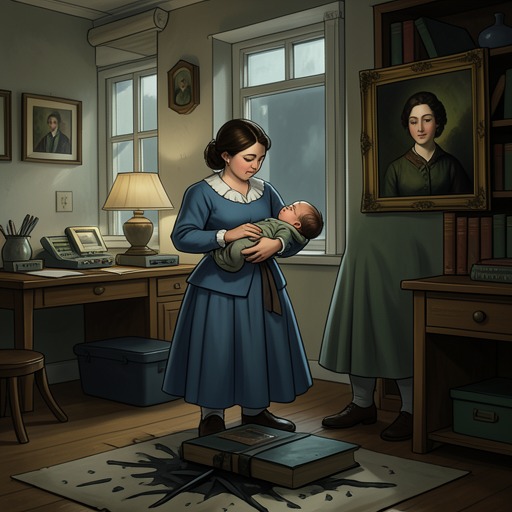
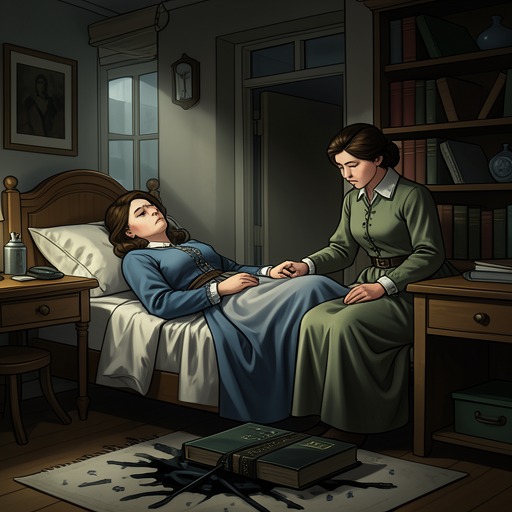
This account makes the confession more than a medical prognosis. Beth interprets her short life through the pattern of her actual attachments: home, family, service, and affection. Her modesty is not presented as emptiness. She recognizes that her sphere has been small, yet the narrative shows that within it she has made herself indispensable through tenderness and practical care. Earlier, she had held the dying baby of Mrs. Hummel until the doctor arrived, learned that the child had scarlet fever, and faced the danger of infection because she could not abandon the suffering family. During Beth's own crisis, Dr. Bangs's request that Mrs. March be sent for and Jo's despair that Beth no longer recognized them reveal how completely the household's sense of safety depends upon her recovery.
Beth's faith is equally important because it is enacted rather than argued. She cannot explain the belief that gives her courage to relinquish life, but she trusts God and nature as sources of strength for both this life and the next. She does not claim to be glad to die; life is still sweet to her. Her honest formulation is that she is trying to become willing. In this way, the confession preserves fear, grief, and attachment rather than replacing them with an artificial serenity.
What Beth Asks of Jo
Beth asks Jo to tell the family when they return home, fearing that those who love her most may be too blind to see what she sees. She wants them prepared, especially because Meg has John Brooke and the babies to comfort her, while Jo will need to stand beside their parents. Jo still tries to call the truth a sick fancy and says that she has not given up hope, but Beth's request quietly assigns her a future duty.
The disclosure therefore redirects Jo's life. Later Beth tells her that when she is gone, Jo must take her place and care for Father and Mother. She warns Jo not to value splendid books or seeing the whole world above this work, declaring that love is the only thing that can be carried beyond death. Jo accepts the charge and renounces her former ambition, replacing it with the goal of loving service. Beth's secret thus produces an outward consequence before her death: it gives Jo a task, a moral orientation, and a way to continue their relationship through action.
The sisters' conversation also clarifies Beth's place among the March daughters. Beth compares Jo to a gull, strong and wild, drawn to storms and wide seas; Meg resembles a turtledove, and Amy a lark whose ambition rises toward the clouds but whose heart remains attached to home. The comparison makes Beth the intimate observer of the family, someone whose apparent quietness contains a precise understanding of each sister's nature. Her approaching departure will not merely remove a beloved child; it will alter the emotional and ethical balance of the household.
Consequence and Ending
The confession prepares the reader for Beth's death without making that death emotionally easier. In the spring, the family and the natural world seem to accompany her toward the end: the sky clears, the earth turns green, flowers appear, and birds return to say goodbye. Beth is guided through the Valley of the Shadow by her parents, who finally give her up to God. The earlier image of the tide is fulfilled when it goes out easily, and Beth dies before dawn in the home where she first drew breath, with one loving look and a little sigh.
Her revelation changes the meaning of the final parting. Death is not an abrupt secret imposed upon the family; it is a truth Beth has already shared with Jo and used to prepare the living. The household's grief remains intense, but it is joined to gratitude for Beth's serenity and for the love that has been transferred into Jo's promised care. The event's deepest significance lies in this transformation: Beth cannot stop the tide of physical life, yet by speaking she prevents her death from becoming only a loss. She turns knowledge into preparation, preparation into responsibility, and responsibility into a continuing form of love.